Molybdenum Copper Alloy (MoCu Alloy)
The Advanced Composite for Precision Thermal Management and Electronic Packaging
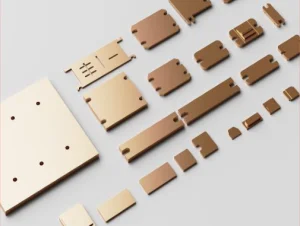
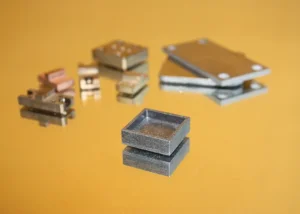
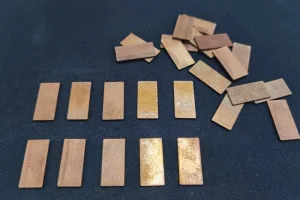
Molybdenum Copper Alloy (MoCu) is a sophisticated composite material strategically designed to combine the low coefficient of thermal expansion (CTE) and high stiffness of molybdenum with the exceptional thermal and electrical conductivity of copper. This unique pseudo-alloy, typically fabricated through powder metallurgy techniques, delivers an unparalleled solution for advanced thermal management and electronic packaging challenges.
Product Details
- Exceptional Thermal Conductivity: Leverages copper's inherent high thermal conductivity (160-250 W/m·K), ensuring rapid heat dissipation.
- Low & Customizable CTE: Provides a low CTE (6-9 ppm/°C) tailored to match semiconductor materials like Si or GaAs.
- High Electrical Conductivity: Retains 50-70% IACS, ideal for high-current applications.
- High Stiffness: Prevents warping or deformation under fluctuating thermal loads.
- Good Machinability: Allows for the production of intricate shapes required in advanced electronics.
- Hermeticity: Dense, non-porous structure ensures excellent sealing capabilities and low outgassing.
- Non-Magnetic: Essential for medical and high-precision electronic environments.
Applications
- High-Power Electronics: Heat sinks and substrates for CPUs, GPUs, IGBTs, and RF power devices.
- Optoelectronics: Laser diode mounts and optical housings requiring thermal alignment stability.
- Electrical Contacts: Resistance welding electrodes and EDM electrodes for wear-resistant, high-current performance.
- Microwave & RF: Waveguides and transistor bases for high-frequency telecommunications.
- Aerospace & Defense: Thermal control substrates for avionics and satellite systems.
Frequently Asked Questions
What is the primary advantage of MoCu? It offers a combination of low CTE and high thermal conductivity, ideal for semiconductor packaging.
Is MoCu magnetic? No, it is inherently non-magnetic, making it suitable for sensitive electronic applications.
Can the CTE of MoCu be adjusted? Yes, the CTE can be customized by altering the molybdenum-to-copper ratio during fabrication.
What is the thermal conductivity range of MoCu? It typically ranges from 160 to 250 W/m·K depending on the specific composition.
Is MoCu suitable
for vacuum environments? Yes, its dense microstructure provides excellent hermeticity and low outgassing.